The problem
Modern life creates weak links — rounded shoulders, tight hips, and deep stabilizers that switch off. The result is pain and injury risk.
How We Train
Here every repetition is measured, so we know you built what that day was for. This is what is actually happening while you lift.
01 · The three day types
Your week is not the same session repeated. Each day builds something different, and the AI-based strength measurement system confirms on every repetition that you were building the thing that day was for.
You will feel powerful, not exhausted.
You will feel a deep, satisfying pump with zero wasted effort.
You will leave feeling looser, taller, and more connected to your body.
Everybody else runs one of these and calls it training.
Light weights, long sets, week after week. That is most group training, and it is one corner of one day. Worse, the weight is usually light enough that the muscle never fully switches on, so they are not even getting the part they parked on.
02 · Structural days
Modern life creates weak links — rounded shoulders, tight hips, and deep stabilizers that switch off. The result is pain and injury risk.
The hidden muscles — transverse abdominis, multifidus, pelvic floor, deep hip and spine stabilizers — that lock you stable so you can move safely.
Find the weak links with AI screening, wake up the deep stabilizers, correct left-right imbalances, build structural strength, restore posture.
Move better. Lift heavier with less risk. Fewer aches, better balance — a body back in balance.
03 · How it works
Underneath the days sit three methods. All three start in the same place — the biggest and strongest part of your muscle has to switch on, the part that sits idle in ordinary daily life. There are exactly three ways to make that happen.
The three methods.
A weight that is real for you, for very few repetitions. The whole muscle switches on the instant you pick it up, because nothing smaller in there can move it. This is the neural day. You leave stronger, not wrecked.
A weight you can handle comfortably, moved as fast as you can mean it. The speed is the demand, not the weight. This is where speed and power come from — the half second that catches you when your foot clips a curb.
A weight in the middle, kept going for longer. The muscle switches on at the end of the set, once the smaller part can no longer finish it alone. This is the muscle day — shape in shorter sets, staying power in longer ones.
Dynamic Effort uses the lightest weight in the building and it is the one almost nowhere else trains, because without measuring speed there is no way to know you did.
How we know which road you are on.
A weight you can barely move comes up slowly. A weight that is easy comes up quickly. You already know that without anyone teaching it to you. So the speed of the weight tells us how hard your muscle is actually working on that repetition — and each of the three methods has its own speed.
The AI-based strength measurement system tells us exactly what level of effort you are putting in, which method that repetition actually landed in, and whether it was the one we meant to put you on that day.
You produce the effort. The artificial intelligence makes sure it landed in the one we were building that day, on every single repetition.
Your speed drops as a set goes on — everyone's does. When it drops past the line we set for that day, the set is finished and the system says so.
No junk reps. Nothing wasted.
A repetition in the zone we aimed for is what we call a Maximally Effective Rep. Getting you as many of those as possible is the entire job.
What nobody else has.
Without a reading like that, the load has to be chosen by feel. That is how it has always been done. When it fails, nobody finds out for months. Here you find out on the repetition.
Most programs have no way of knowing when you have had enough, so they either stop too early or keep going past the point where the set was still doing anything.
The technology the system runs on was tested against an eleven-camera motion capture rig, the kind universities use, on competitive lifters working near their limit. It read what the cameras read. That study is published and you are welcome to look it up.
A trainer stands with you and teaches you how to move, every session. The AI cannot see your back round. A person can. You need both, and nobody else gives you both.
04 · More is not better
Most training programs are built on the idea that more is better. More repetitions, more classes, more sweat, more days a week. It is a reasonable assumption and it is the one almost everybody makes.
Your muscle responds to a specific kind of effort rather than to the total amount of work you do. Effort outside that range still tires you out and still wears on your joints, and it builds nothing you came for.
Everywhere else, nobody can tell which reps were in that range. Here the artificial intelligence reads it on every repetition.
The right kind of work is the only kind that counts.
05 · Why you stopped
You do not enjoy it. Almost nobody does. You do it because somebody told you it was the responsible thing to do, and you are trying to be responsible.
The thing that gets you what you came for is the thing you have been walking past.
Most people would rather lift weights. They just never start. The reason is not laziness. You walk into a weight room and everyone in it looks like they know exactly what they are doing, and nobody has ever shown you how. Rather than stand there feeling like you do not belong, you get on a machine where at least you cannot do it wrong in front of anybody.
That is the whole reason. Nobody ever showed you how.
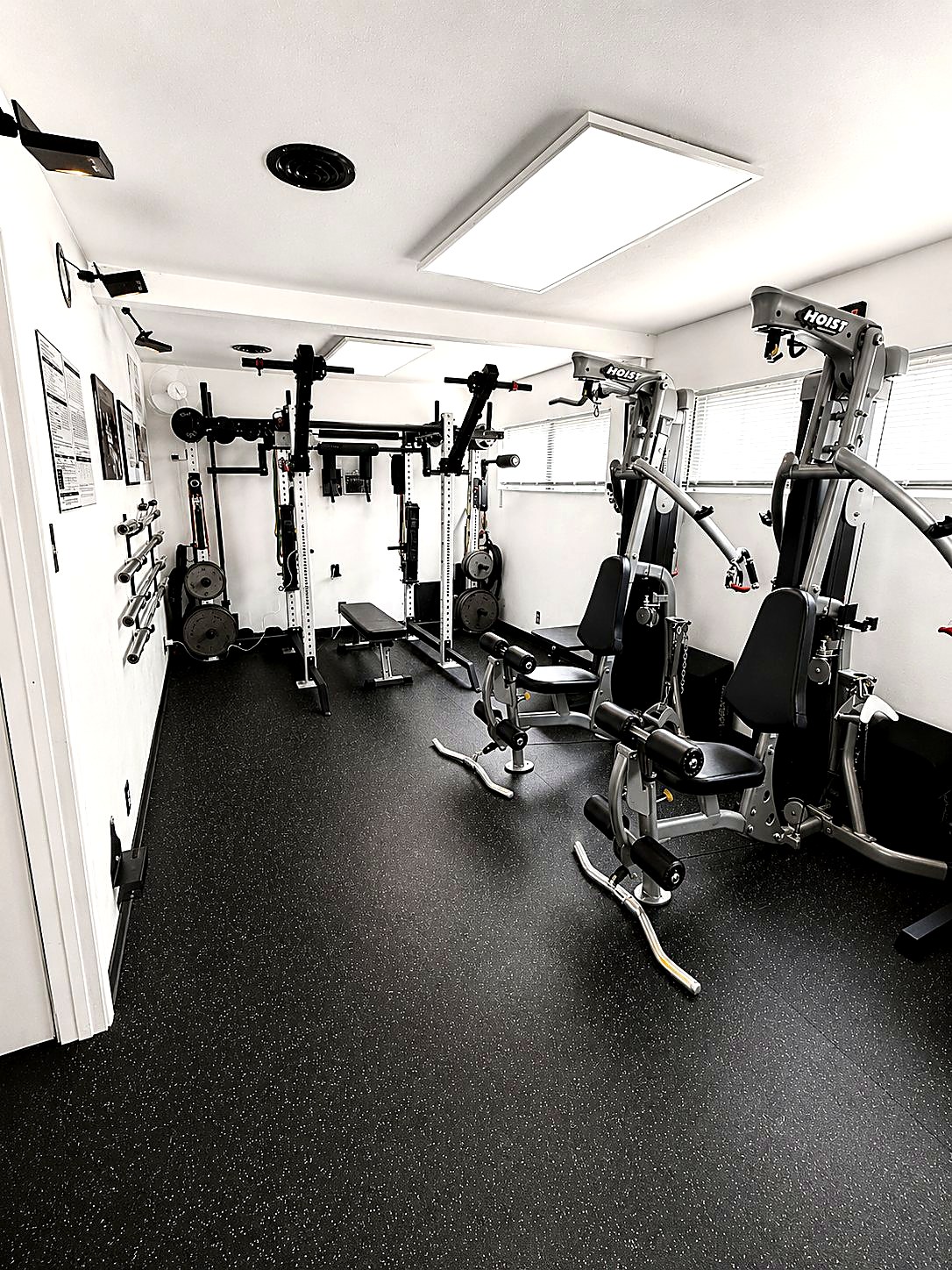
Here there are eight people in the room and a trainer standing with you for the entire session. That problem is solved on your first day.
06 · Conditioning
We do not do cardio here the way you are used to it. No treadmill, no bike, no hour of keeping your heart rate up. That work burns calories while you are doing it and very little once you stop, and it builds no muscle, no strength and no power. It is the least you can get for an hour.
What we do instead is lift across all three. Neural. Muscle. Structural. And your conditioning, built into the same session instead of bolted on after it.
Your heart does two different jobs. One is stamina, which is how long it can keep going. The other is strength, which is how much it can do when something demands a lot from it right now.
Every program sold as cardio builds the first one. Almost nothing on the market builds the second. You already know this if you have ever met somebody who runs five miles a day and still cannot carry a couch up a flight of stairs.
We build both of them, inside the lifting. Long stretches of work with very little rest build the stamina. Short, all-out efforts with short rests build the strength.
I do not change the exercise to get one or the other. I change how long you rest.
Muscle is what changes the fat side of it. A body carrying more muscle burns more all day, sitting still, doing nothing. An hour on a treadmill never buys you that.
The strength results carry over into every other part of your fitness.
Everything moves at once and nothing gets added on top. The AI is what makes that possible, because every rep has to be in the zone for the quality we are building that day.
Some of them may know it. None of them can do it, because doing it means knowing which zone every single rep was in. And almost nobody knows about it yet.
07 · The budget
Most people have about three hours a week for this. An hour a day at the very most. You are not going to spend your life in a gym and I would not ask you to.
Plenty of things are good for you. The question is what those three hours should buy.
If you walk, keep walking. It is good for you and I am not going to tell you to stop. Walking the dog, taking the stairs, getting your steps in — all of that is already doing work for your heart and lungs, and you are not training for a marathon.
Muscle is the job, and walking never touches it.
Nothing in your ordinary week asks your muscles to do anything difficult. Nothing has, for twenty years.
Gives you more of something your week is already giving you for free.
Feels good and I have nothing against it. What it gives you is range you cannot hold under your own power, and being pushed into a position you cannot control is a good way to get injured.
Is still a cardio class. The weights being light is the smaller problem. Nobody in that room is asking you to move the weight as fast as you can, or to keep going until you cannot finish another repetition. They are asking you to keep up for an hour.
So spend the three hours on the one thing nothing else in your life is doing. You give up nothing: your conditioning is built into the session and your range of motion comes from lifting through a full range under load. This is the only gym that puts those three hours on the one thing your week is not already giving you, and then measures whether it worked.
08 · The system
It decides what you train on a given day, which method you use to train it, and which variation of that method you run. All three day types get covered inside the same week, instead of chasing one at a time and losing the other two while you do.
The AI runs underneath all of it, reading every repetition and making sure you are in the zone the day calls for.
Underneath that sits a library of advanced training techniques that most people in this industry have never been taught and almost nobody outside of it has heard of. They are the reason your body keeps producing results instead of stalling out at week six the way it always has before.
You do not need to know their names. What you need is somebody who knows which one to use on you, and why, on a given Tuesday.
09 · Nutrition
You get two numbers. How many calories to eat in a day, and how many to burn in a day, trackable on a Fitbit, a Garmin or whatever you already wear.
Not nutritional guidance. Two numbers.
The plan is built around the food you already eat, arranged in the proportions that produce fat loss. You are not given a list of foods you have never cooked.
A coach texts you every day. Not a newsletter and not an app notification. A person who knows what you are supposed to be doing that day, checking that you did it.
Come and get measured. Twenty-five minutes, no charge.
Request Your Longevity Analysis